
Corporate video training is undergoing a transformation.
The old publishing model is slow, reactive, and difficult to measure. With L&D and communications teams stretched thin, business demands often force speed to take precedence over strategy. In turn, video completion rates define success rather than actual business outcomes.
With the introduction of AI, many companies are asking the question:
Can AI videos reshape corporate training and enablement at scale, without subjecting viewers to ‘AI slop’?
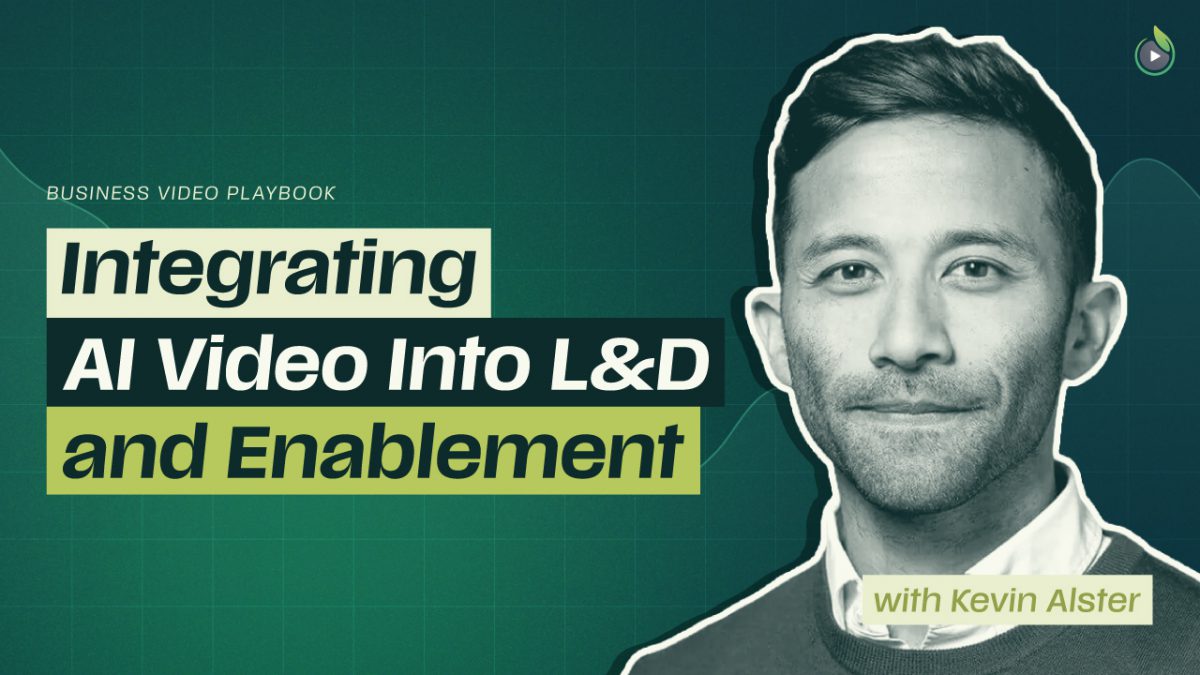
In this episode of the Business Video Playbook, we sat down with Kevin Alster, Strategic Advisor for Synthesia, who helps L&D and communication teams close the gap between what’s possible with AI and real-world workflows.
Watch now to see how AI video is modernizing corporate training and communications, plus gain an effective framework for getting started.
How AI Video Is Transforming Corporate Training and Communications
AI videos for corporate L&D and communications teams promise cost and workload reduction. A straightforward example is the ability to translate existing text-based documents and training materials into dynamic, video-based content.
However, Kevin Alster argues that AI’s role extends beyond resource efficiency. He believes AI is shaping a new future of business training and communications that prioritizes behavioral change and actual business impact.
Of course, L&D and internal comms professionals want scalable, high-quality content with fewer production barriers. But does the vision of AI meet reality?
Alster says it can,
“An average day of shooting can cost $25K–$50K. I saw AI video cut down on the worst parts of production. You can get a first draft or prototype more quickly. If you need edits, you don’t go back to the linear, expensive process of reshooting and re-editing; you change the script like a document, hit publish, and the new version instantly replaces the old one.”
— Kevin Alster, Strategic Advisor at Synthesia
Companies embracing AI are also finding more ways to streamline production, such as:
- Course localization: Tailor content more easily to specific subjects, audiences, languages, or cultures, which is essential for global companies.
- Content Relevance: Content is easily updated to match new announcements and product releases, reducing the support burden and meeting user information needs.
Therefore, AI video for corporate training and communications can provide incremental business benefits that would otherwise require additional solutions.
Interactive and Personalized: The Future of AI Video for Training & Communications
Beyond production efficiency, AI is transforming how people learn.
Alster argues that it’s time to move past this old-school view of absorbing information that relies on the traditional classroom model. AI fuels the shift from passive learning to interactive, personalized, and context-driven experiences designed to change behavior.
“We have a very antiquated view of how information gets into the brain. With the traditional classroom model, there is an expert at the front and a student at a desk listening to the expert. LLMs are changing the way people interact with information. Information takes a different form depending on the input.”
— Kevin Alster, Strategic Advisor at Synthesia
AI also enables learning in the flow of work (“just-in-time” learning), where content meets the person’s need at the moment they’re solving a problem.
Video has traditionally been a one-way medium. But Alster argues that generative AI is changing this by making video interactive through branching scenarios that give viewers choices and links to supporting resources for deeper learning, all without disrupting their flow.
This personalized learning experience comes to life through:
- Real-Time Feedback and Role-Play: AI avatars simulate scenarios and give instant, objective feedback for faster growth.
- Instant Content Curation: Employees receive precise answers and resources on the spot, eliminating the need to dig through an LMS.
- Gen AI Tutors: Integrate with enterprise talent management systems to assess learning needs and deliver customized training plans.
- Adaptive Learning Paths: AI adjusts onboarding and upskilling in real time based on performance and experience.
Alster posits that as AI video continues to advance, corporate learning becomes less about delivering information and more about enabling behavioral change at scale.
3 Best Practices: Using AI Videos for Corporate L&D and Comms
With a less intensive production process, AI videos offer more than just speed and scalability. Ensure your AI videos are effective training tools with these best practices.
1. Evaluate Behavioral Change, Not Completion Rates
Technological skills are rapidly evolving: “39% of workers’ skill sets will be disrupted within five years,” according to the World Economic Forum. To fill these gaps, companies need a fundamental shift in how knowledge is consumed and applied.
Instead of emphasizing completion rates, Alster suggests evaluating behavioral change:
“Learning isn’t the point. The point is changing someone’s behavior. You might learn something as a result of that. Learning is the product of trying to figure out how to tackle a particular challenge. But in the end, we are looking for a change in behavior.”
— Kevin Alster, Strategic Advisor at Synthesia
Watch Alster share more in this short video.
2. Avoid “AI Slop” with Quality Over Quantity
Alster emphasises purpose over output for L&D teams. Despite the ease of production in the age of AI, quality remains foundational over quantity.
“An overabundance of low-quality content makes it nearly impossible for users to find what’s actually helpful, creating unnecessary friction and eroding trust. The winning strategy is to focus on quality, thoughtful storytelling, and purpose to stand out from the inevitable wave of low-effort, low-value AI-generations.”
— Kevin Alster, Strategic Advisor at Synthesia
Watch Alster share more in this short video.
3. Connect Sales Growth to Customer Education
Historically, the impact of customer education is challenging to quantify. By integrating AI into a Customer Relationship Management (CRM) system, companies can measure the correlation between customer education initiatives and business outcomes.
“Customer education becomes a growth driver when you can connect the cost of content to the customer lifecycle.”
— Kevin Alster, Strategic Advisor at Synthesia
One way to make this connection is by linking customer actions (such as a lead watching a how-to video) to the actual customer journey and business outcomes (the company receives fewer support requests while sales continue to expand).
Watch Alster share more in this short video.
How to Start Using AI Video in L&D: The Three E’s Framework
To help L&D teams get started without being overwhelmed, Alster offers a three-part framework for adopting AI video:
- Engagement: Create an AI teaser video for your course. Focus on the pitch and what the person will gain from it. Focus on bite-sized videos that deliver information.
- Experiences: Bring stories to life with AI. Consider how you can use video to model situations, such as two avatars role-playing a difficult employee-manager conversation.
- Enablement: Show how something is done step-by-step. A short video might replace screenshots in a knowledge base article, allowing the viewer to follow along.
Watch Alster share more in this short video.
In short, start with simplicity and gradually build complexity into your AI video workflow. As you determine the workflow that fits your business needs, AI offers an opportunity for L&D to be more strategic.
Are AI Videos The Future of Workplace Learning?
Alster’s vision of AI videos for L&D training enables professionals to step away from the manual production grind and focus on what matters: powerful stories, organizational change, and measuring the impact of training on real business objectives.
Is your business turning to AI videos for corporate training? If so, what tools and workflows have proven most effective? If not, why and what hesitations remain?
We’re continuously exploring the evolving world of artificial intelligence; check out related content for more information and watch the full episode with Kevin Alster of Synthesia.