


Across industries, AI is reshaping how businesses work, scale, and communicate. But in equal measure, consumers are seeking more genuine interactions. Video trend predictions for 2026 reflect this tension, with a focus on authentic, personalized, and interactive video experiences.
“The future of video is deeply human, even when powered by tech. Learners want authenticity. Teams want flexibility. And everyone wants content that feels made for them.”
— Max Shak, Founder/CEO, nerD AI
We asked experts in learning and development (L&D), corporate communications, and marketing what video trends they predict and how their strategies are evolving. Here’s a look at the top video trends for 2026, grounded in insights from industry leaders.
2026 Video Trends: Scaling Authentic, Personalized, and Interactive Content with AI
Cross-Industry Video Trends for 2026
1. AI-Assisted Video Workflows Gain a Role
We don’t expect AI video tools to replace video production workflows in 2026; however, AI tools are poised to become common additions in tech stacks. Businesses will increasingly turn to AI tools to enable small teams to make bigger contributions with greater workflow efficiency.
“Most organizations aren’t replacing humans; they’re building workflows where AI drafts scripts, auto-generates multiple versions, and creates rapid voiceovers so teams can iterate instantly. It’s becoming the default for internal training videos, especially when policies or product knowledge change weekly.”
— Albert Richer, Founder & Editor, What Are The Best.com
For example, we recently experimented with AI tools for repurposing a blog post into a video. From the experiment, a five-step workflow emerged that allows us to produce a video in as little as two hours. We then expanded this process, incorporating in-person cutaways in our gift guide for filmmakers to add polish and a cozy vibe.
2. Authentic, Casual Video Continues to Win Engagement
The theme of authentic video emerged repeatedly in our Business Video Playbook interviews in 2025. From real estate and tourism to product marketing and video-based learning, authenticity has become shorthand for content that feels true-to-life and requires minimal production value.
“The biggest shift I’m seeing is away from the ‘corporate polish’ look. The content that actually builds trust now? A founder talking directly to the camera about a real challenge they faced, shot on their phone, with zero editing.”
— William DiAntonio, CEO, Brand911
Unpolished videos were hugely popular on social media in 2025, with viewers seeking genuine glimpses into a brand or person’s life over staged ads. This video trend is expected to expand in 2026 and become increasingly common in corporate environments. Learn why and how to ditch the script with Alex Hoff, CEO of CoverStory.
Video Trends in L&D and Corporate Comms
3. AI Video Personalization & Avatars Build Momentum
Businesses are using AI tools to generate personalized videos from core content. This cost-effective trend is gaining popularity in corporate training, communications, and even marketing. For example, a company can create multiple onboarding videos tailored to specific employees from a single video or script.
“We created thousands of sports highlights for different fan segments from one game. Corporate comms teams will do this in 2026: one CEO town hall becomes 50 department-specific versions with relevant examples spliced in. The tech finally works reliably.”
— Maria Consuelo Gonima, Founder, Big Smile Co.
AI Avatars are also expected to become more common, especially as executive stand-ins for corporate communications: “[Imagine] your VP of Sales records themselves once, then L&D teams generate dozens of personalized sales training videos using that avatar without ever booking their calendar again,” said Ariel Coro, Tech Expert & Keynote Speaker.
4. Language Localization Becomes Table Stakes
Speaking of video personalization, AI video tools already enable companies to create multi-language voice overs, making it easier for global companies to localize content. But in 2026, more businesses are expected to generate videos in multiple languages from a single script, producing content that’s truly customized to each viewer.
“When I demonstrated Sora (OpenAI’s text-to-video model) earlier this year, the immediate reaction was, ‘We can finally create Spanish-language training videos without flying crews or hiring translators.’ For L&D teams serving diverse workforces, this means you’ll be able to type scenario-based training prompts in English and generate localized video content in Spanish, Mandarin, or Portuguese within minutes. The cost savings are huge compared to traditional dubbing.”
— Ariel Coro, Tech Expert & Keynote Speaker
We recently interviewed Kevin Alster, Strategic Advisor at Synthesia, for his perspective on how AI is transforming L&D and corporate learning in 2026: “The real challenge is keeping every version of your content up to date as the product evolves. AI lets small teams scale creation, localization, and updates at the pace of product change.” Watch the full interview for more.
5. Branching Scenarios Move Into the Mainstream
Branching scenarios provide a choose-your-own-path learning approach with videos structured into short, highly specific snippets. Instead of a static video playlist, learners can watch videos in an order that will best support their learning or company role.
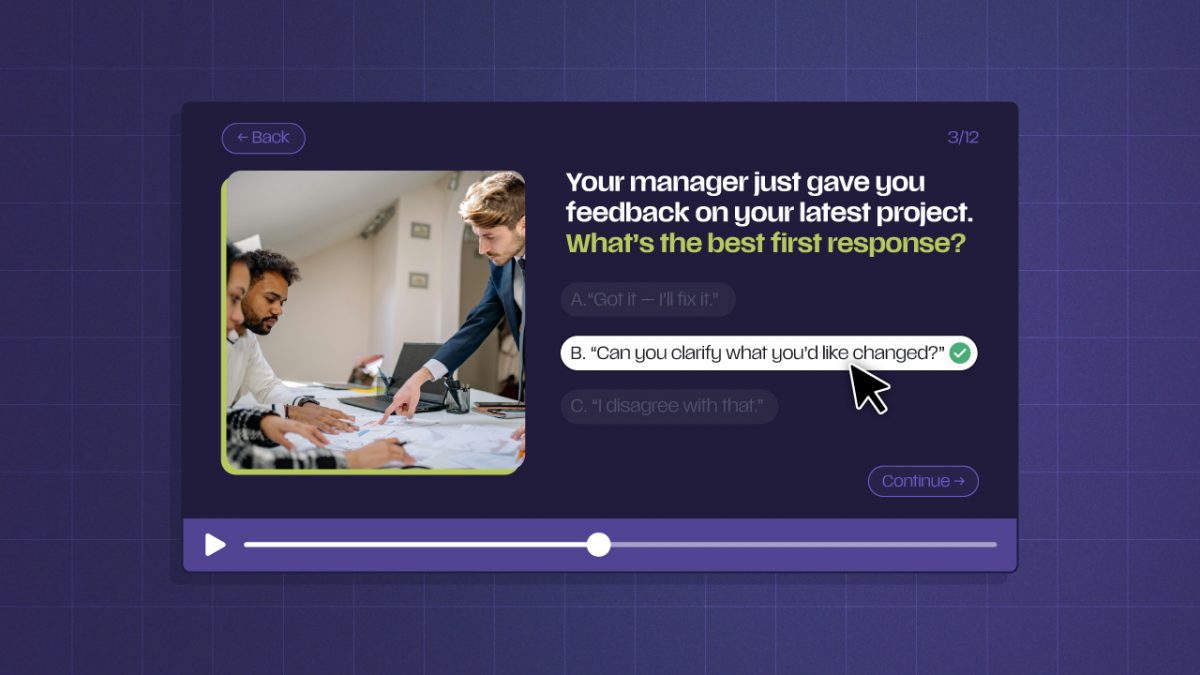
Branching Scenarios May Use Quizzes to Determine the Next Video
“We built a library of over 30 expert-taught seminars that faculty can drop into their curriculum based on specific gaps. For corporate training, this means building non-linear video modules employees can sequence based on role or project need, rather than forcing everyone through the same timeline.”
— Cheryl Cassaly, Chief Marketing Officer, Rehab Essentials
In 2026, branching scenarios for video training are expected to become increasingly common. One-pagers, quizzes, AI-generated feedback, and other interactive elements may be included alongside videos to encourage applied learning.
Video Trend Predictions in Media & Marketing
6. Long-Form Video Makes a Comeback
Short-form video content delivered reliable ROI in 2025, and that isn’t expected to change in 2026. However, long-form videos and livestreams are gaining momentum on social media once again as AI fatigue grows and people crave content that’s unmistakably based in the real world.
“People are tired of performance. They crave reality in the spaces they once used to escape it. This is why user-generated storytelling, behind-the-scenes transparency, and community-driven reviews dominate engagement metrics.”
— Armel Dussol, Founder & Creative Director, MDM Media
Aligned with the trend of authentic videos, long-form content typically uses fewer cuts, minimal graphics or b-roll, and soft background music, if any at all. “I see a shift towards ‘slow content.’ This is the opposite of the high-energy videos we see everywhere today,” shared JoAnne Loftus, President and Owner of Archival Designs.
Long-form B2B Video Example
For businesses, one strategy is to use strategic short-form content that is repurposed from longer-form content, which is more likely to build trust and drive conversions.
7. GEO Video Optimization Becomes the Competitive Edge
Generative engine optimization (GEO) is the new evolution of SEO for AI-driven search engines. Traditional SEO still helps you rank in link-based search results, while GEO helps large language models (LLMs) understand and cite your brand within generated answers.
“Generative AI (GenAI) solutions are replacing user queries that previously may have been executed in traditional search engines. This will force companies to rethink their marketing channels strategy…Content should continue to demonstrate search quality-rater elements such as expertise, experience, authoritativeness, and trustworthiness.”
— Alan Antin, Vice President Analyst at Gartner
Since AI search engines retrieve and synthesize information, video content with strong metadata (especially when paired with accessible transcripts) becomes surfaceble in AI search. AI tools like ChatGPT, Perplexity, and Google AI Overviews can reference the content, cite your brand, or even directly share your video with the person searching.
In 2026, well-structured content about your product offerings (ideally in both video and text), distributed across your channels, becomes valuable input for both GEO and SEO.
8. Decentralized Discovery Makes Video Even More Valuable
Modern buyers rarely move through the sales funnel in a linear fashion. The days of someone searching Google, landing on a webpage, and then buying a product are largely behind us. Over the last few years, consumers have shifted toward gathering information across multiple channels.
The average buyer might start with a quick Google search, refine their understanding in ChatGPT, look for user experiences on TikTok or YouTube, and check Reddit for opinions. By the time the buyer encounters your brand, they’ve done their homework. They want to understand why your specific solution is the right one.
“The pattern I’m seeing for 2026 is that video is moving away from ‘content marketing’ and toward ‘decision acceleration’. People want to see the actual person they’ll be working with, hear how they think, and make a decision faster. When the right person explains the right thing in under two minutes, it eliminates weeks of back-and-forth.”
— Hooman Bahrani, Founder, Birch Stream Digital
In 2026, video increasingly serves as a decision-stage asset, helping buyers consolidate what they’ve learned across channels and move to purchase with confidence.
What Are Your 2026 Video Trend Predictions?
As AI-generated content floods every channel, a key question arises: Will video prioritize speed and scale, or will authenticity become the differentiator audiences seek out?
In 2026, businesses are moving from experimenting with AI to using it in practical, day-to-day ways that support how teams operate. However, as technology evolves, authenticity and personalization remain valuable because they deepen engagement and build loyalty.
AI won’t replace authenticity and personalization. But long-term success will depend on how deliberately teams balance these qualities with automation.