
Disclaimer: This post is for informational purposes only and does not constitute legal advice. Laws vary by jurisdiction; if you’re navigating a real liability situation, please consult a qualified attorney.
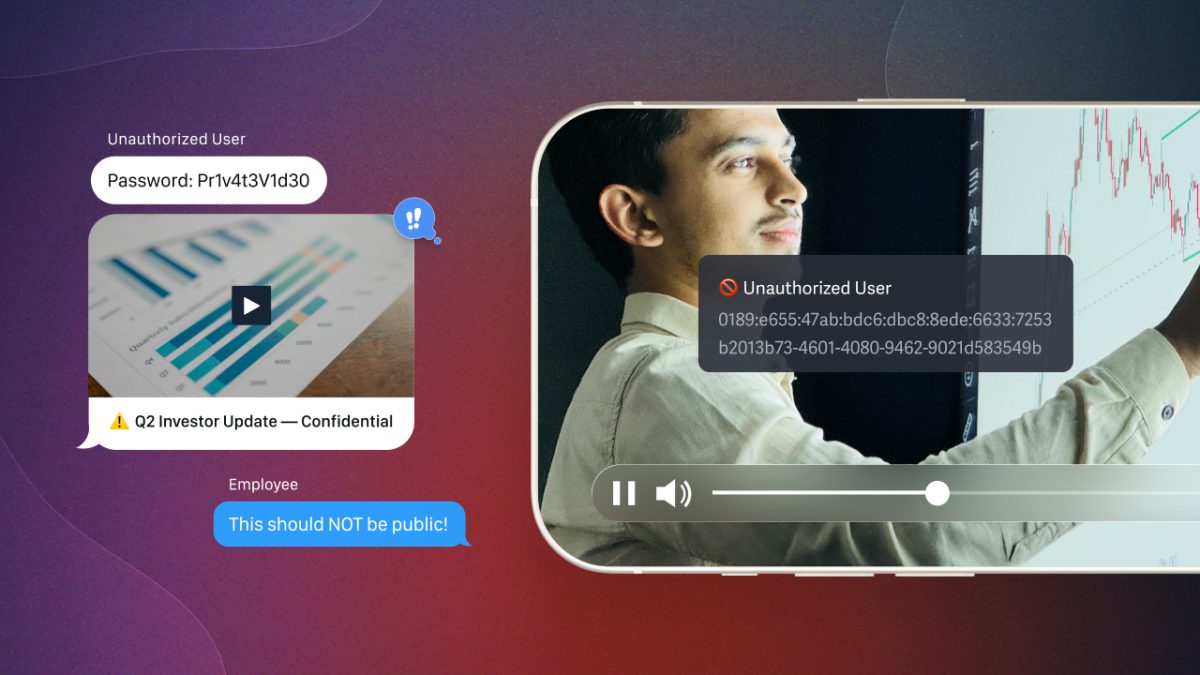
A healthcare company’s internal compliance training surfaces on a public forum. A law firm’s confidential client briefing is forwarded to opposing counsel. An agency client’s unreleased campaign video gets shared through an insecure link.
Business video leaks can have years-long repercussions for reputation and revenue, and those consequences are only amplified when liability is involved. The key is ensuring your business can demonstrate it did everything reasonably possible to protect sensitive videos.
When a private business video leaks, containing the damage is the immediate priority. But close behind it comes a harder question: who is responsible? The answer is almost never simple.
Learn what determines liability in a video leak, the legal and regulatory frameworks that shape those outcomes, and what your business can do to reduce both risk and exposure.
Table of Contents
- What Determines Liability When A Video Leaks
- Why Video Leaks Can Be a Legal Problem
- The Most Common Liability Scenarios
- The Legal Agreements That Determine Liability
- How Regulatory Compliance Affects Liability
- How Businesses Can Limit Liability
- What To Do If A Video Leak Already Happened
- Liability Follows the Sharing Method
What Determines Liability When A Video Leaks
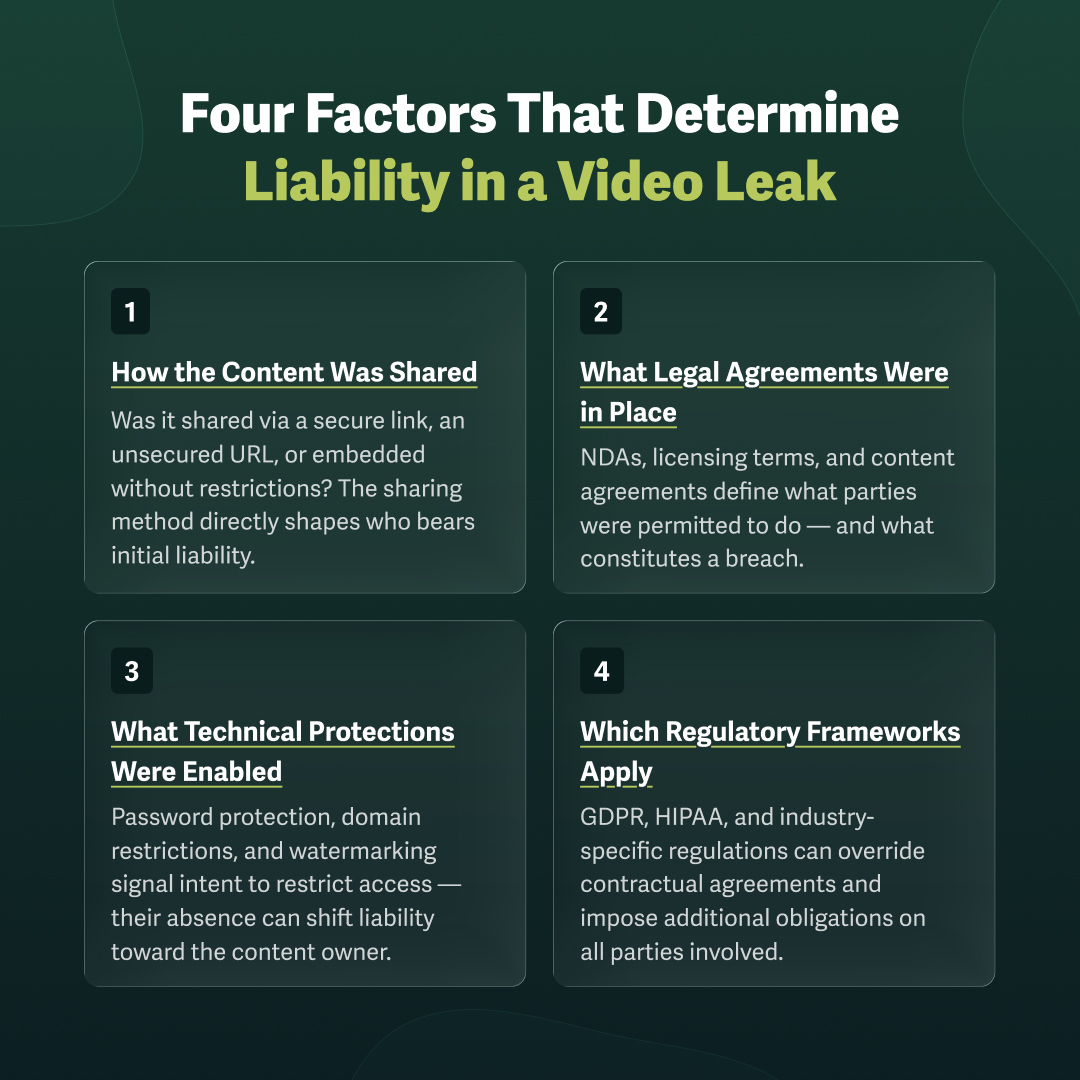
Liability when an online business video leaks depends on four key factors:
- How the content was shared
- What legal agreements were in place between the parties
- What technical protections were or were not enabled on the video
- Which regulatory frameworks apply to the content and the audience
For example, a business that shared a confidential investor update via an unsecured link may be liable for the leak, even if an employee forwarded it. A client who redistributed an agency’s unreleased campaign video may have breached a contract — but if the original link lacked access controls, the agency may face scrutiny as well.
Liability follows the weakest point in the chain, not only the last person who touched the file.
Why Video Leaks Can Be a Legal Problem
Video Carries Legal Weight
Confidential business video content is increasingly a carrier of legally protected information. Depending on what a video contains, it may be subject to serious legal protections, eg:
- Internal training videos: often include personally identifiable employee data
- Client deliverables: may reproduce proprietary business strategies covered by a master service agreement
- Recorded compliance training: can contain proprietary risk assessments or client account details covered by confidentiality agreements
- Investor updates: may include material non-public information that triggers securities compliance obligations
When that video leaks, the legal consequences do not wait for anyone to determine whether it was intentional. An unauthorized disclosure involving personally identifiable information, trade secrets, or regulated data can trigger breach-of-contract claims, regulatory investigations, and civil litigation, regardless of how the leak occurred.
Leaks Trigger Legal Frameworks
Most businesses treat video security as a technical concern, something managed by IT or Operations, rather than a legal one. In practice, sharing a confidential video through an insecure channel can be a legal decision with real consequences, even if the person making it didn’t know that at the time.
A leak can activate any of the following simultaneously, depending on the content and the parties involved:
- Non-disclosure agreements
- Master service agreements
- Data privacy regulations
- Intellectual property protections
- Employment contracts
The legal exposure from a video leak is not a downstream consequence of a security failure. It is the security failure itself, expressed in legal terms.
The Business Often Bears Liability
The business that created and shared the video is almost always the first party scrutinized when a leak occurs. Under US laws, the data owner is generally liable for any losses resulting from a data breach. This is often the case even if the security failures are attributable to a third-party provider, because many vendor contracts exclude consequential damages and cap direct damages. That principle extends to video content: the organization that produced and distributed it bears primary responsibility for ensuring that the distribution method was appropriate for the content’s sensitivity.
Even if an employee forwarded a link without authorization, or a client passed a video to a competitor in violation of a contract, regulators and opposing counsel will examine whether the original sharing method made those outcomes foreseeable and preventable.
The Most Common Liability Scenarios
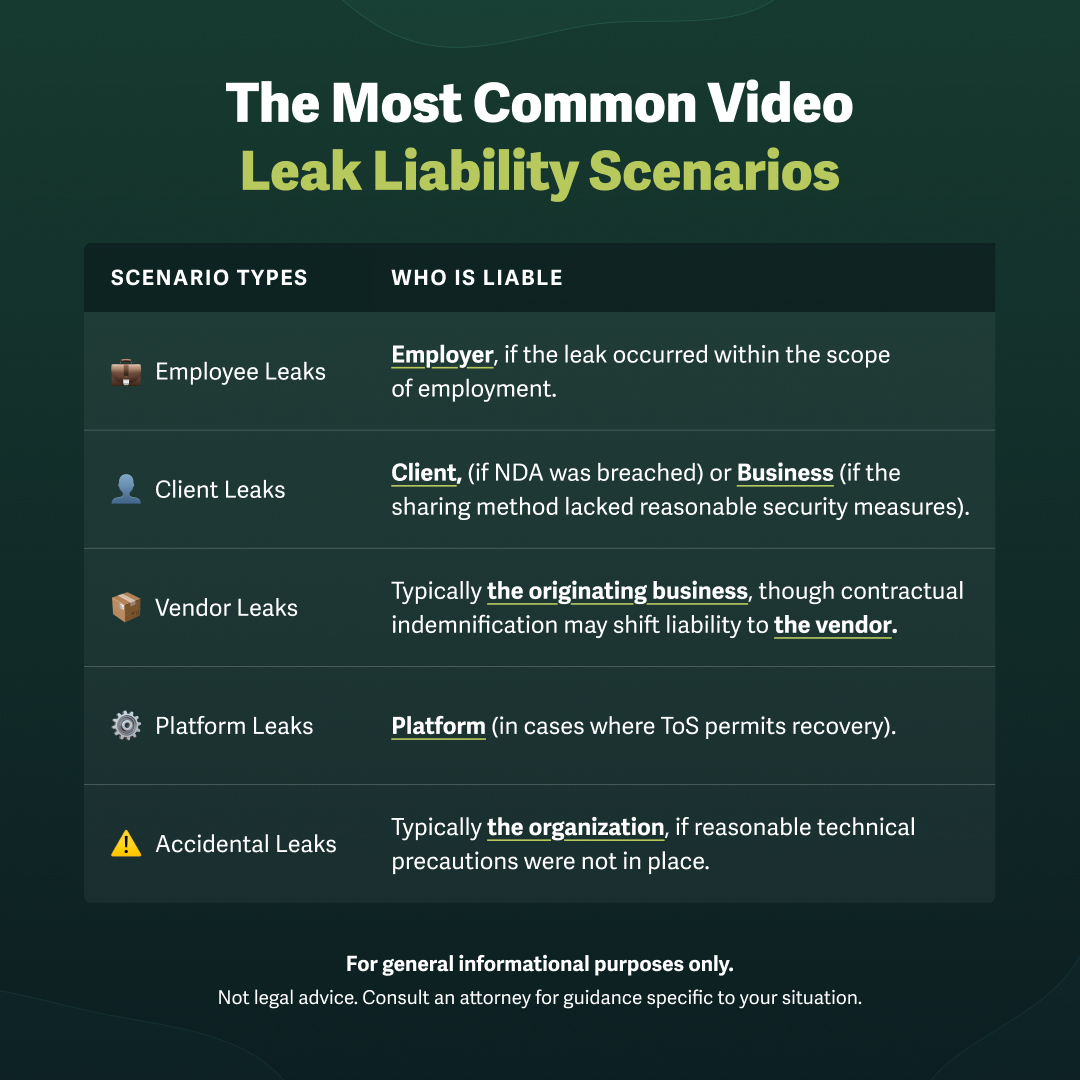
Employee Leaks
Employee leaks are among the most frequent causes of confidential video exposure and among the most legally complex.
When The Business Is Liable
When an employee shares a confidential video outside the organization, the question of who bears liability is shaped by the legal doctrine of respondeat superior: an employer is responsible for an employee’s wrongful acts when those acts occur within the scope of employment.
If an employee shares a confidential video while performing job duties, the employer is likely exposed to liability for the leak. For example, a sales representative shares a confidential client presentation with a prospect who was never cleared to receive it.
When The Employee Is Liable
If the employee acts entirely outside the scope of their role, the employer’s direct liability may be reduced. However, courts examine these fact patterns carefully, and outcomes vary significantly by jurisdiction. For example, an employee downloads a confidential video and sells it to a competitor for personal gain.
Overall, employers may be held vicariously liable for tortious acts committed by employees in the scope of their employment. But that liability does not extend to acts that are clearly inappropriate to or unforeseeable in the context of the employment.
Importantly, pursuing an employee for a leak does not protect the business from parallel claims by affected clients, regulators, or other third parties. Both liability tracks can run concurrently.
Client Leaks
Client leaks occur when a business shares a confidential video deliverable with a client, who then redistributes it to a third party without authorization.
When The Client Is Liable
In this scenario, the client has almost certainly violated the terms of a master service agreement or a non-disclosure agreement. Most NDAs include provisions for legal recourse in the event of a violation, including monetary compensation for any harm caused by the breach, employment termination, or even criminal liability in cases involving intentional disclosure.
In practice, establishing the client’s liability typically requires proving three things:
- A confidentiality agreement was in place at the time the content was shared
- The recipient knew the content was confidential
- The redistribution caused measurable harm
When The Business Is Liable
However, the business that created the deliverable is not automatically insulated from scrutiny. If the video was shared in an insecure manner and without identity verification, a court or regulator may find that the method of sharing was insufficient given the content’s sensitivity.
The legal question is not only whether the client breached an agreement, but also whether the business took reasonable technical precautions to make that breach more difficult.
Vendor Leaks
Vendor leaks present a particularly underappreciated liability risk. Many businesses share access to internal video content with third-party contractors, production agencies, or technology vendors as part of a normal workflow.
When The Business Is Liable
When a vendor experiences a security failure or shares the content without authorization, the originating business typically remains liable. While third-party vendors and service providers have an obligation to keep your data safe, this does not relieve the originating organization of its data security responsibilities.
In a lawsuit brought by a former employee of a biopharmaceutical company, the employer was held liable for the publication of employee data following a breach of its payroll software provider, not the software company itself.
The principle applies broadly: the organization that owns the content is accountable for its protection, regardless of which third party held it at the time of the leak.
When The Vendor Is Liable
Contractual indemnification clauses — which obligate the vendor to cover losses arising from failures on their end — can shift some liability back to a vendor when the failure is clearly attributable to the vendor’s platform or negligence.
In practice, most vendor contracts cap damages and exclude consequential losses, which limits the real-world value of an indemnification claim. More importantly, indemnification doesn’t insulate the originating business from regulatory scrutiny or reputational damage. Regulators look at the data owner first.
Platform Leaks
Unlike vendor leaks, which involve human actors mishandling content, platform leaks occur at the infrastructure level, when the hosting environment itself is compromised.
When The Platform Is (Rarely) Liable
When a platform suffers an infrastructure-level security failure, its terms of service generally limit its liability for resulting losses. Most SaaS agreements cap damages at the value of the contract and exclude consequential losses, meaning the business whose content was exposed may have little legal recourse against the platform, even when the failure was clearly the platform’s fault.
This situation puts the originating business in a difficult position: liable to its own clients, employees, or regulators for the leaked content, but largely unable to recover those losses from the platform that failed to protect it. The practical implication is that platform selection is itself a liability decision.
Accidental Leaks
Accidental leaks — a forwarded link, a shared password, a mistaken email — are far more common than intentional disclosures, and they carry real legal exposure regardless of who triggered them.
When The Business Is Liable
Regulatory fines, legal penalties, and reputational damage can result from an accidental disclosure, even when there was no malicious intent. Intent is a factor that affects the severity of consequences, not a factor that eliminates legal exposure.
A willful NDA breach will face greater penalties than an accidental one. However, accidental breaches resulting from inadequate access controls or insufficient encryption can still establish liability. The question regulators and opposing counsel ask is not whether the leak was intentional, but whether it was preventable.
The Legal Agreements That Determine Liability
Non-Disclosure Agreements (NDA)
Non-disclosure agreements (NDA) are the most commonly relied-upon legal instrument for protecting confidential business information, yet they are also among the most frequently misunderstood.
An NDA creates a legal obligation on the signing party to keep covered information confidential and provides grounds for legal action if that obligation is breached — whether between an employer and an employee, a business and its clients, or a company and its vendors.
A breach can have serious consequences, with violations potentially escalating to IP litigation depending on the nature of the information disclosed. However, NDAs define liability after a leak has occurred; they do not prevent the leak itself.
An NDA that covers “confidential business information” may or may not be interpreted to cover video content specifically, depending on how it was drafted and how courts in the relevant jurisdiction apply it. Agreements drafted before video became a primary medium for business communication often contain gaps that create ambiguity in enforcement.
Master Service Agreements and Client Contracts
Master service agreements and client contracts are the primary legal framework governing the relationship between a business and its clients. When a confidential video leaks, these contracts have significant implications for liability. Ownership clauses, permitted use provisions, and confidentiality terms all affect which party is responsible for protecting the content and what remedies are available if it leaks.
A contract that assigns ownership of a video to the client upon delivery, for example, may shift the burden of protecting that content to the client upon handoff — but only if the agreement clearly addresses that point. If the contract is silent on video content, digital distribution, or access control requirements, the gap is likely to be interpreted against the drafting party.
Employee Agreements
Employee agreements are another critical layer of protection that is frequently underdeveloped in practice. Most include general confidentiality provisions, but few specifically address digital content. This gap matters when a video leaks.
Employment agreements that specifically name the following as categories of protected confidential information leave less room for the argument that an employee didn’t understand their obligations:
- Video content
- Training materials
- Client recordings
- Investor updates
Confidentiality agreements should cover not just employees but also external vendors and contractors with access to video content. Confidentiality obligations should also survive the employment relationship, not just cover the period of active employment. That provision is standard practice but should be explicitly included.
Platform Terms of Service
Platform terms of service define what the video hosting provider is and is not responsible for. In most cases, those terms significantly limit the platform’s liability for leaks that result from the user’s configuration choices. SaaS agreements typically shift responsibility for account-level security — passwords, access controls, and configuration — to the user rather than the platform.
The technical choices a business makes within a platform are the decisions the platform will point to when liability is contested, including:
- Whether login protection is enabled
- Whether downloads are restricted
- Whether domain-level access controls are applied
Agreements define the legal framework, but the technical sharing method determines whether that framework actually provides meaningful protection. A securely configured sharing workflow, backed by a clear contractual agreement, provides stronger protection than either alone.
How Regulatory Compliance Affects Liability
GDPR
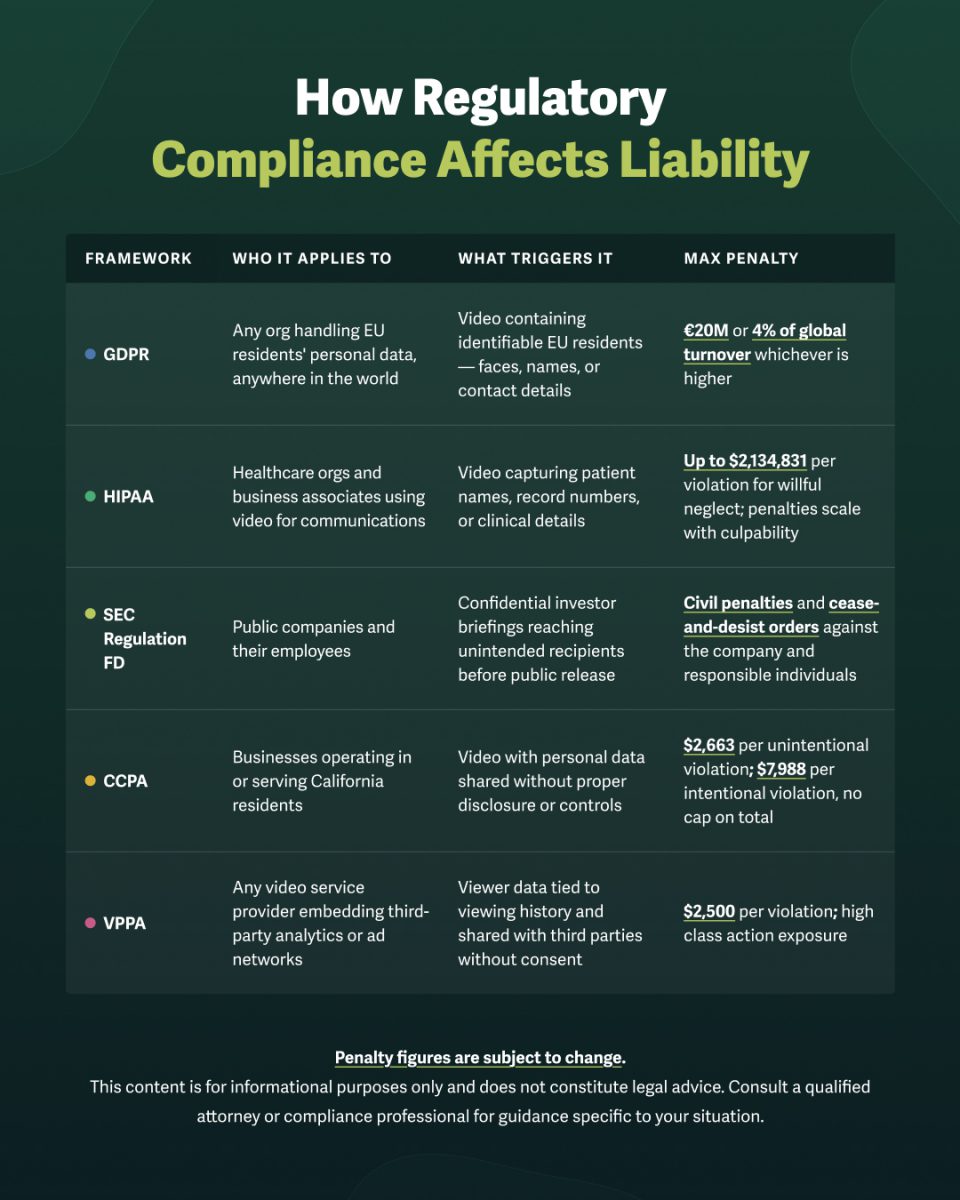
GDPR is the regulation most businesses encounter when thinking about data privacy, but its application to video content is frequently underestimated. If a leaked video contains personal data belonging to EU residents — an employee’s name and image appearing in a training video, a client contact’s information captured in a recorded presentation — the organization that produced and shared the video may be subject to GDPR obligations regardless of where the business is located.
Organizations can face fines of up to €20 million or 4% of their global annual turnover for more severe violations involving unauthorized data disclosure. Regulatory fines globally reached $19.3 billion in 2024 for non-compliance with privacy laws across major jurisdictions.
The key principle is that the business is responsible for implementing appropriate technical and organizational measures to protect personal data. A video shared through an insecure channel without adequate access controls is unlikely to satisfy that standard.
HIPAA
HIPAA imposes strict liability on healthcare organizations and their business associates for disclosing protected health information without authorization. A single video that captures an identifiable patient name, medical record number, or clinical detail is a potential HIPAA violation if it reaches an unintended audience. Violation penalties scale with culpability, from $141 per violation for unknowing infractions up to $2,134,831 for willful neglect that goes uncorrected.
The most effective mitigation is matching access controls to content sensitivity. Training videos should avoid protected health information (PHI) where possible, so that content with greater exposure falls entirely outside the scope of HIPAA.
Where training needs to reference real cases or clinical records, the full weight of HIPAA applies. Where PHI cannot be avoided — recorded consultations, clinical demonstrations, case review sessions — access should be limited strictly to those with a legitimate need. The narrower the distribution, the smaller the risk of violation.
SEC Regulation FD
SEC Regulation FD (Fair Disclosure) prohibits public companies from selectively disclosing material nonpublic information to certain investors or analysts before making it available to the general public. A recorded investor update, earnings preview, or strategic roadmap presentation that reaches an unintended recipient before public release is a potential Regulation FD violation.
The SEC can pursue civil penalties and cease-and-desist orders against both the company and the individual employees responsible. In a 2024 enforcement action, DraftKings paid a $200,000 penalty for a non-intentional selective disclosure. For public companies, every recorded financial or strategic briefing should be treated as a regulated disclosure, with access controls that limit distribution strictly to its intended audience.
The California Consumer Privacy Act (CCPA)
The California Consumer Privacy Act applies to businesses operating in California or serving California residents, which includes most US businesses. Unlike GDPR, the United States has no single comprehensive federal data privacy law. Instead, compliance is managed through a patchwork of state-level laws and sector-specific federal regulations.
Under CCPA, personal information includes names, email addresses, and device identifiers — all of which can be captured through video content or the platforms used to distribute it. If a business shares video containing this data without adequate access controls, fails to disclose how viewer data is collected, or does not honor consumer data requests, it may be in violation. Civil penalties range from $2,663 per unintentional violation to $7,988 per intentional violation, with no cap on the total amount.
Video Privacy Protection Act
The Video Privacy Protection Act is the only federal statute specifically governing the disclosure of video-related information. It is violated when a video service provider knowingly discloses a consumer’s personally identifiable information, tied to their viewing history, to a third party without their consent.
The Act carries liquidated damages of at least $2,500 per violation, and in a class-action context, that figure can scale quickly. The risk is highest when video is embedded alongside advertising networks or third-party analytics tools that share viewer data without consent. Hosting video on a platform that does not serve ads or share viewer data with third parties significantly reduces this exposure.
How Businesses Can Limit Liability
Secure Video Sharing Workflows
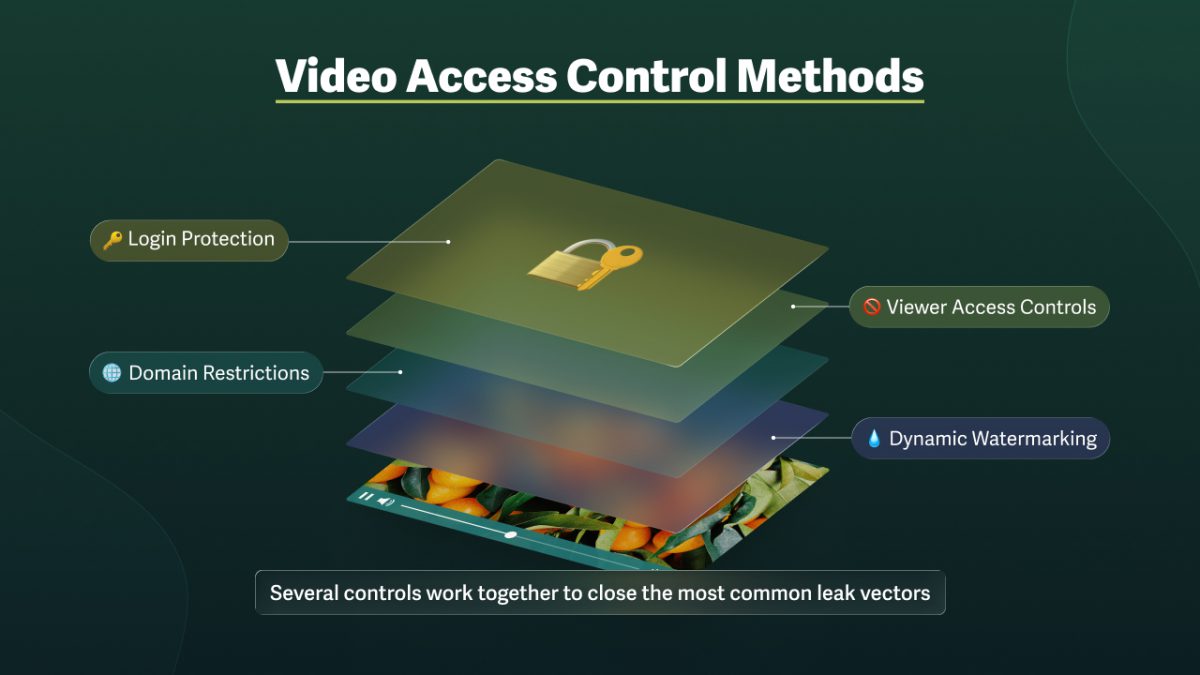
The most reliable way to limit liability from a video leak is to make it significantly more difficult for a leak to occur in the first place.
How a business shares video is itself a liability decision. An investor update, a client deliverable, or a training video may carry legal weight regardless of how trusted the intended recipients are, and the sharing method should reflect that.
When liability is involved, secure video sharing reduces the risk of accidental leaks and makes intentional distribution traceable, providing organizations with a significantly stronger legal position.
For a breakdown of the most effective methods for securely sharing video content, see our guide to secure video sharing.
Review and Strengthen Legal Agreements
On the agreements side, the practical steps are straightforward, though some may require coordination with legal counsel:
- Review NDAs and client contracts: ensure they specifically address video content and digital distribution
- Add contract provisions: define what constitutes a confidential video, how recipients may use it, and what happens if unauthorized redistribution occurs
- Update employee agreements: make clear that confidentiality obligations cover recorded meetings, training materials, client recordings, and investor updates
- Work with legal counsel: audit your highest-risk content categories and assess whether current agreements and technical controls meet the regulatory frameworks that apply to your business
What To Do If A Video Leak Already Happened
Immediate Response
Containment
The first priority when a video leak is discovered is containment. If the video was shared through a platform with access controls, revoke access immediately for all current viewers and generate new credentials for the parties who should retain access.
If the video was shared via a generic link, the link cannot be retroactively secured but it can be taken down, re-uploaded with appropriate controls, and shared via a protected link.
Evidence Preservation
Before making any changes, preserve all evidence of the original sharing configuration, the viewer access log, and any communications related to the video. A clear timeline is essential for both legal and regulatory purposes and should document:
- What happened
- How the breach was discovered
- How many people or systems were exposed
- Whether the breach is still ongoing
Legal Counsel
Engage legal counsel before making any public statements or regulatory filings. Legal counsel can assess the scope of notification obligations, advise on the content of any required communications, and help coordinate responses across affected parties.
For a practical framework for managing content incidents, see our corporate video disaster recovery plan.
Notification Obligations
Notification obligations vary depending on the nature of the content and the applicable regulatory framework. If the leaked video contained personally identifiable information covered by GDPR, HIPAA, CCPA, or other applicable regulations, you may have a legal obligation to notify affected parties, regulators, or both within specific timeframes. Under GDPR, organizations must report a data breach to the relevant supervisory authority within 72 hours of becoming aware of it.
Remediation Phase
Once the immediate response is complete, assess how the leak happened:
- What sharing method was used
- Whether access controls were enabled
- Whether the content was downloaded before detection
- Whether the relevant agreements were in place at the time
Then, close the gap in your workflow. If the leak occurred because a generic link was used for sensitive content, implement login protection and viewer-level access controls going forward. If it occurred because a vendor had unmonitored access to internal video content, review your vendor agreements and access policies.
A complete audit trail of viewing sessions is the most valuable tool in this investigation. It tells you who watched the video, when, and for how long — which determines the scope of the incident and the parties that need to be involved in the response. Platforms that log viewer activity at the individual level make this investigation significantly more tractable.
Liability Follows the Sharing Method
Regulators will look at the protections in place before the video leak, not just what happened afterwards. Liability is shared, contested, and expensive. The business that created and shared the content is almost always the first party examined when something goes wrong.
scenarios may be varied, but the legal outcome in each turns on the same foundational questions:
- What agreements were in place?
- What technical controls were enabled?
- Was the sharing method appropriate for the sensitivity of the content?
The strongest legal protection available to a business is also a technical one. A sharing workflow with the right controls does more than reduce the probability of a leak, it changes the legal analysis entirely. When a leak occurs in a well-controlled environment, the business can demonstrate reasonable precautions, identify the source quickly, and contain the damage before it compounds.
For businesses, traceability, speed, and documented precautions shifts the legal narrative from negligence to diligence, and secure video controls make it possible.